The Clockmaker's Silence
When the great clock in Finch’s workshop stopped at 2:17 a.m., the town realized that something far more unsettling had halted.
Harsh Valecha
· 6 min read
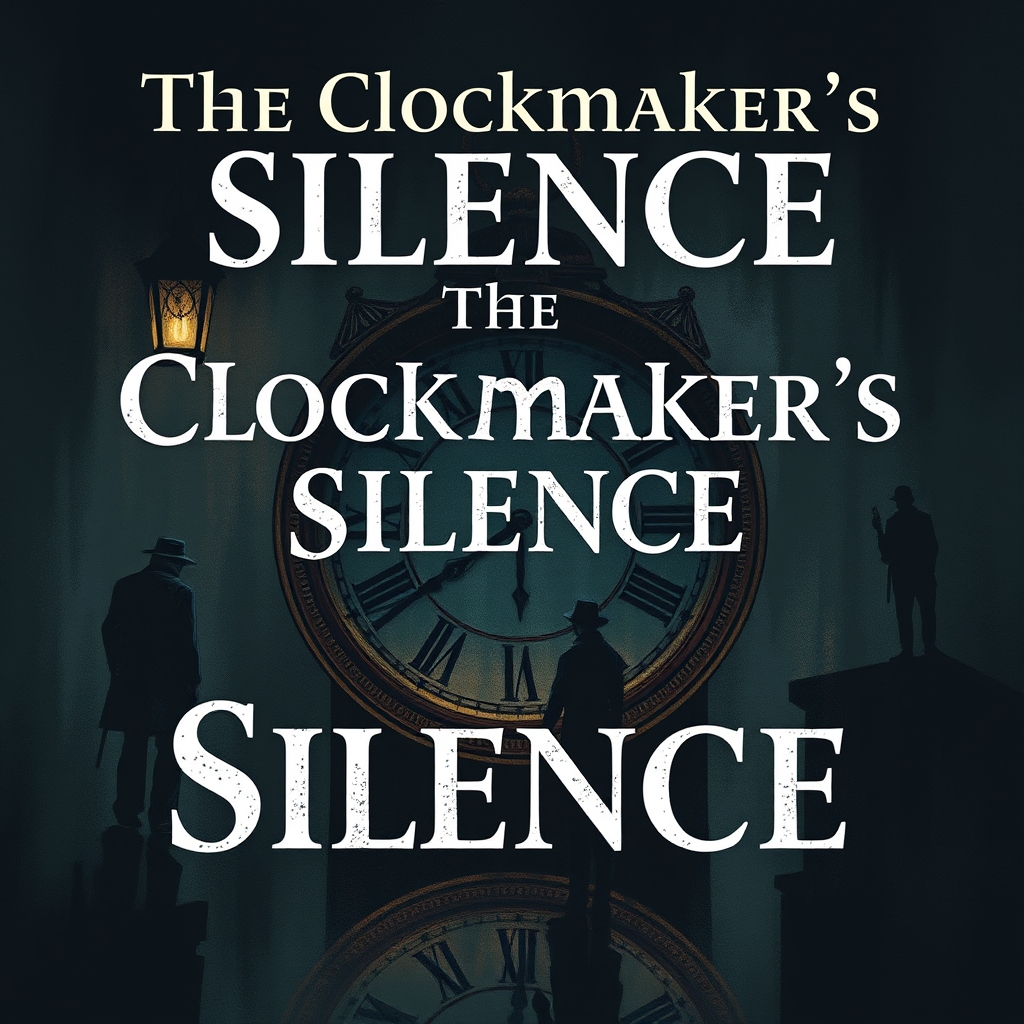
When the great clock in Finch’s workshop stopped at 2:17 a.m., the town of Harrowgate realized that something far more unsettling had halted.
Elias Finch was as much a fixture of the town as the stone bridge that arched over the river. For forty years he had crafted timepieces that chimed in every home, school, and shop, and his own workshop was a cathedral of ticking, brass gears and polished mahogany. The night his door remained shut, the midnight chime that usually rang from his mantelpiece never sounded, and the next morning his workbench lay empty, a single brass cog glinting on the floor like a dropped secret.
Detective Mara Vale was called in, not because she was the town’s most senior detective, but because she was the only one who could read the case through the fog of her own limitation. Mara was colorblind; the world unfolded to her in shades of gray and texture, not in the bold reds and greens that others took for granted. In a town where a crimson scarf could be a clue, her mind compensated with an uncanny attention to scent, sound, and the way light fell on surfaces. She arrived at the workshop with a notebook, a magnifying glass, and a small vial of lavender oil she kept for calming nerves.
The first people she questioned were the three who lived and worked most closely with Finch. Agnes Whitlow, the housekeeper of twenty years, had a steady hand and a quiet demeanor. She claimed to have been at home, nursing a cold, when the clock stopped, and she had a prescription bottle of cough syrup as proof. Her motive, if any, was the modest inheritance she would receive if Finch died without a will. Thomas Reed, the apprentice, was a bright but impatient young man who had recently been denied a partnership in the shop. He insisted he was at the local tavern, a fact corroborated by the barkeep who remembered his loud laughter over a round of ale. Thomas’ motive was obvious: jealousy and the desire for the workshop’s ownership. The third was Mrs. Lila Hart, Finch’s next-door neighbor, a widowed florist who often borrowed sugar and flour for her cakes. She said she had been tending to a delivery of lilies at the market, a claim supported by a receipt she produced. Her motive lay in a long-standing feud over a property line that Finch had refused to move.
Each alibi seemed solid, yet Mara sensed a pattern in the way they described the night. Agnes mentioned the sharp smell of oil that lingered in the hallway; Thomas spoke of a soft humming from the old wall clock in the tavern; Lila described the crisp rustle of paper as she unfolded a delivery note. The adjectives struck Mara because they corresponded to the textures she could rely on. She also noted the faint scent of lavender that clung to the brass cog—lavender was the fragrance Agnes used in her laundry.
Mara began to catalog the physical clues. The brass cog was not part of any of Finch’s known clocks; it matched the missing gear from a pocket watch that had been displayed in the shop window weeks before. The watch’s second hand was stuck at 2:17, the exact moment the workshop fell silent. On the ledger beside the workbench, a tea stain marred the top line of the day’s entries; the tea was a rare Darjeeling blend that only Lila’s shop sold. A torn photograph lay crumpled in the trash—half of it showed a younger Finch standing beside a woman whose face was obscured; the other half was missing, as if someone had deliberately cut it out. Finally, a silver spoon, engraved with the initials “A.W.”, was found hidden under a loose floorboard.
Each clue seemed to point in a different direction, and Mara realized the case was a web of overlapping motives. She revisited the workshop at night, letting the silence speak. The old wall clock in the corner, which Thomas had described as humming, actually ticked irregularly, its pendulum slightly off balance. When she gently nudged it, a faint click echoed, revealing a hidden compartment behind the clock’s case. Inside lay a stack of letters, all addressed to Finch, each sealed with a wax stamp bearing a lily.
Reading the letters, Mara discovered that Finch had been corresponding with an anonymous benefactor about a patent for a new escapement mechanism. The benefactor threatened to expose a scandal: Finch had once repaired a clock for a corrupt councilman, tampering with its timing to hide a vote. The councilman, in turn, had pressured Finch to destroy the records. Finch had refused, planning instead to hand the evidence to the town archives. The letters were signed only with a single, looping initial: “L.”
Now the pieces fit. Lila Hart, the florist, had a hidden connection to the councilman—her late husband had been the man’s accountant, and she had inherited his loyalty. The lavender scent on the brass cog was a red herring; Lila used lavender oil in her shop to keep insects away from the flowers, and the oil had drifted through the open window onto the gear when she entered the workshop to retrieve the letters she had hidden. The tea stain, however, was genuine; Lila had poured a cup of Darjeeling while reading the letters, inadvertently staining the ledger.
But the decisive clue was the silver spoon. Engraved with “A.W.”, it belonged to Agnes Whitlow. Mara recalled that Agnes had mentioned she kept a silver heirloom for good luck. When confronted, Agnes broke down. She confessed that she had discovered Finch’s plan to expose the councilman and feared the ensuing scandal would ruin the town she loved. She had hidden the letters, intending to protect Finch, but when the councilman’s men came for the evidence, she panicked. In the confusion, she slipped the silver spoon into the floorboard to mark the spot, then fled, leaving the brass cog—taken from the pocket watch she had been polishing—as a misguided token of time stopped.
Agnes didn’t kill Finch; she had simply hidden the letters and left the workshop. Finch, realizing the danger, had fled the town that night, taking only the pocket watch with him. He was later found in a distant village, exhausted but alive, having walked for days to escape the reach of the councilman’s influence. The missing gear, the stopped second hand, and the locked compartment were all his way of signaling that time had been deliberately frozen to buy him a chance.
The truth rippled through Harrowgate. The councilman was arrested, the archives received the scandalous documents, and the town’s clocks began to chime again, this time with a renewed honesty. Mara, standing before the restored workshop clock, felt the weight of her own perception shift. She realized that in a world of colors, the textures of truth could be felt, and that sometimes the most subtle scent—lavender, tea, oil—carries the loudest confession.
In the end, Finch returned to Harrowgate, not as a victim but as a survivor, his hands still steady over gears, his heart forever marked by the night time stopped. Agnes, though forgiven by many, chose to leave the town, taking with her the silver spoon that had become a symbol of both loyalty and the heavy price of secrecy. Mara watched the town’s people gather beneath the clock tower, their faces illuminated by the amber glow of lanterns, and felt a quiet resolve: every mystery, no matter how tangled, is a series of small, observable moments waiting for someone who looks beyond the obvious.